

Quick Takeaways
- An AI humanizer is a tool that rewrites AI-generated text to alter the vocabulary, sentence structure, phrasing, rhythm, and style that detectors and readers associate with machine writing.
- AI detectors typically rely on several linguistic and statistical signals, with perplexity (how predictable word choices are) and burstiness (how much sentence structure varies) among the most commonly discussed, alongside other stylometric and pattern-based features depending on the tool.
- Independent research has found detector accuracy can fall well below vendor claims in certain conditions. One frequently cited study found a 61.3% false-positive rate specifically on TOEFL essays written by non-native English speakers, compared to near-zero for native speakers in the same test, a result that doesn’t necessarily generalize to every detector or every type of writing.
- Humanizing text can lower a detection score without actually making the writing better, sound more human, or more accurate. Passing a detector and being genuinely well-written are two different outcomes.
- Detector reliability varies by tool and context, and some companies operate in both the detection and humanization space, which researchers have flagged as worth being aware of when weighing how much confidence to place in either category of tool.
What is an AI humanizer, exactly?
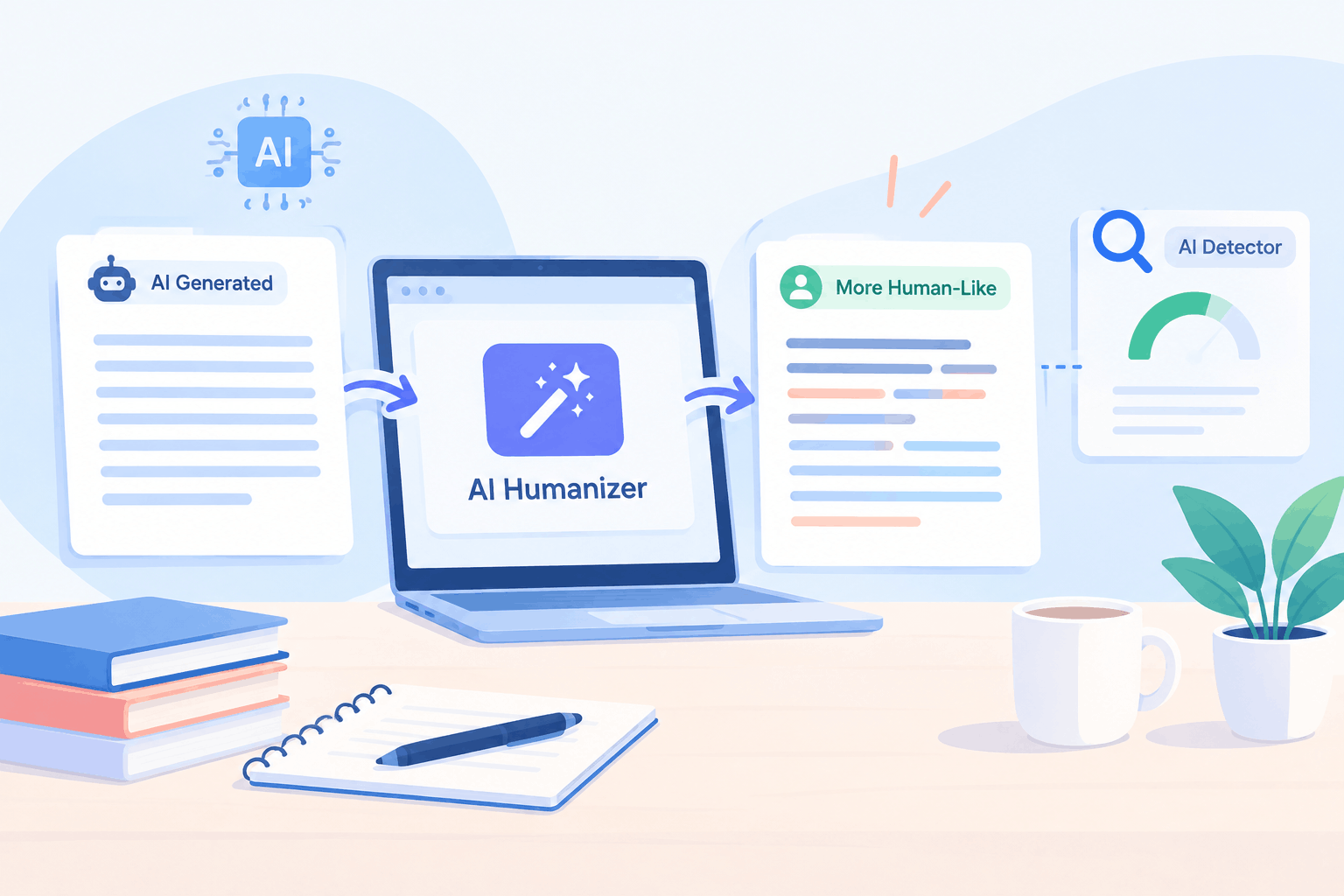
An AI humanizer is a tool that takes text generated by a large language model and rewrites it to reduce the statistical patterns that AI detection software uses to flag content as machine-written. The output is meant to read more naturally and score lower on detection tools like Turnitin, GPTZero, or Originality.ai, without changing the underlying meaning of the text.
It’s easiest to think of an AI humanizer as sitting between two other categories of tool. Generative AI writes the original draft. An AI detector tries to identify whether that draft was AI-written. A humanizer sits in the middle, specifically targeting whatever signals the detector on the other end is likely looking for.
How AI detectors typically decide something might be “AI-written”
To understand what a humanizer is doing, it helps to understand what it’s often working against. AI detectors generally don’t read for meaning or quality. Instead, many rely on statistical properties of the text, estimating a probability based on patterns learned from large datasets of both human and AI writing. Exact methods vary by tool, and most modern detectors combine several signals rather than relying on just one or two, but two commonly discussed properties illustrate the general idea.
Perplexity measures how predictable a piece of text is to a language model. If a model can easily guess the next word in a sentence, perplexity is low. If the wording is unexpected or unusual, perplexity is higher. Because language models generate text by predicting likely next tokens, AI-generated text can exhibit patterns of predictability that some detection systems use as a signal.
Burstiness measures how much sentence length and structure vary across a passage. Human writing can show substantial variation in sentence length and structure, although the amount of variation differs widely between writers and types of text. AI-generated text often sits in a comparatively narrower, more uniform band, with less variation in sentence length and paragraph structure than typical human writing, though the exact pattern differs by model and by how the text was generated.
Beyond perplexity and burstiness, detectors may also weigh other factors such as vocabulary diversity, punctuation habits, repetition patterns, or in some cases proprietary classifiers trained on large labeled datasets. No single signal is treated as definitive by well-designed detection systems.
Put simply: text that scores low on multiple measures like perplexity and burstiness tends to read as a stronger AI signal to many detectors, while more varied, unpredictable writing tends to read as more human. An AI humanizer generally aims to shift a passage’s characteristics away from the first pattern and toward the second, though which specific signals it targets depends on the tool.
How an AI humanizer actually changes the text
AI humanizers can use a range of technical approaches.
Rule-based systems apply a fixed set of transformations: swapping common words for less predictable synonyms, breaking up repetitive sentence openings, adjusting punctuation and paragraph rhythm. These are the older, more mechanical approach, and they’re limited to catching the most obvious, well-known AI patterns.
Machine learning-based humanizers are trained on large datasets of human and AI writing and learn to reproduce the broader texture of human prose, adjusting vocabulary choices, sentence structure, phrasing, rhythm, and style in combination, rather than applying a fixed checklist of swaps. This is the more sophisticated end of the category, and it’s largely why modern humanizers can be harder for some detectors to catch than the rule-based tools that came before them, though results vary depending on the specific detector and humanizer involved.
In practice, a humanizer typically does some combination of the following to a passage: replaces generic word choices with more specific or unusual ones, deliberately varies sentence length so some run long and some run short, reorders clauses to break up predictable rhythm, and introduces small imperfections or stylistic quirks that a purely probability-driven model wouldn’t naturally produce on its own.
Do AI humanizers actually work?
It depends entirely on what “work” means. There’s a real difference between a humanizer lowering a detection score and a humanizer producing genuinely better writing, and conflating the two is where most of the confusion around these tools comes from.
Lowering a detection score is, at least sometimes, achievable. Multiple independent tests have found that humanized or manually paraphrased AI text can meaningfully reduce detection scores, and academic research on adversarial evasion techniques has documented that instructing a model to “increase perplexity and burstiness” during a rewrite step measurably lowers detector flag rates.
But passing a detector doesn’t mean the writing has actually improved, or even that it reliably reads as human to an attentive reader. Text that passes an automated detector can still carry the flatness, vague phrasing, or structural sameness that made it feel AI-generated in the first place. A lower score and better writing are two different outcomes, and a humanizer may be able to achieve the first outcome without necessarily achieving the second.
Why detector reliability is part of this conversation
This is a part many humanizer marketing pages skip entirely, and it’s worth understanding: independent research has found that AI detector accuracy can vary significantly depending on the tool, the type of writing, and who wrote it, sometimes falling well below the figures vendors advertise.
Some detection companies advertise accuracy figures near 99%, though these figures are usually based on the vendor’s own testing conditions. Independent research has sometimes found notably different results under different test conditions. One frequently cited study tested seven commercial AI detectors against a specific set of TOEFL essays written by non-native English speakers and found an average false-positive rate of 61.3% for that particular sample, meaning more than three out of five of those human-written essays were incorrectly flagged as AI-generated. The same detectors, tested against essays from native English speakers in that same study, produced a false-positive rate close to zero. This result reflects one dataset and one set of tools under specific conditions, not necessarily every detector or every type of writing, but it illustrates that detector performance can differ substantially depending on who wrote the text being evaluated.
A commonly proposed explanation for that gap relates to perplexity: non-native writers and English-language learners may use simpler vocabulary and more regular grammatical structures, which can produce a similar low-perplexity signature to the one some detectors associate with AI-generated text. In cases like this, a detector’s flag may reflect linguistic simplicity rather than actual AI authorship, though the extent to which this explains results varies by study and by tool.
This kind of finding has prompted some institutions to reconsider how they use these tools. For example, Vanderbilt University disabled Turnitin’s AI-detection tool after evaluating its reliability and has stated that AI-detector scores should not be used as the sole basis for an academic-misconduct report. Practices vary by institution, but the example illustrates why detector results are increasingly treated as one piece of evidence rather than definitive proof of AI authorship.
Is using an AI humanizer cheating or unethical?
There’s no single clean answer. Whether using an AI humanizer is appropriate depends heavily on the purpose of the writing and the specific rules or expectations governing it, rather than being something the tool itself determines.
Using a humanizer to smooth AI-assisted drafting for casual writing, marketing copy, or a first pass a person then substantially edits themselves sits in a genuinely different category than using one to submit AI-generated academic work as entirely original, undisclosed effort under a policy that explicitly prohibits that. What matters is how the tool is used and whether that use complies with the rules or expectations governing the work. The same tool can be a reasonable editing aid in one context and a policy violation in another.
It’s also worth being aware of a dynamic some researchers have noted in this space: certain companies operate in both the detection and humanization markets, or humanizer products sometimes advertise their ability to defeat specific named detectors by brand. This doesn’t mean either category of tool is inherently untrustworthy, but it’s a reasonable factor to weigh when evaluating marketing claims from either side.
Frequently asked questions
Can AI detectors always tell if a humanizer was used?
No. Detection accuracy against humanized text varies significantly, and independent testing generally shows detection rates dropping once text has been meaningfully edited, paraphrased, or run through a humanizing tool.
Do humanizers change the actual meaning of the text?
A well-built humanizer is designed to preserve the original meaning while altering wording, sentence structure, and rhythm. In practice, quality varies significantly between tools, and some more aggressive rewrites can shift nuance or introduce factual drift, so reviewing the output matters.
Is there a real difference between an AI humanizer and a paraphrasing tool?
The line is blurry, and many tools blend both functions. A basic paraphraser mainly swaps words and restructures sentences for variety. A more advanced AI humanizer specifically targets the statistical signals detectors measure, going beyond surface-level rewording toward disrupting the exact patterns detection classifiers are trained on.
Why did one study find high false-positive rates for non-native English speakers?
The commonly proposed explanation relates to perplexity, a measure of how predictable word choices are. Non-native writers may use simpler vocabulary and more regular grammar, which can resemble the statistical pattern some detectors associate with AI-generated text. This finding comes from a specific study and dataset, and results can vary across different detectors and writing samples.
Should schools or employers rely solely on AI detector scores as proof of AI use?
Some peer-reviewed research and a number of institutional policy decisions suggest detector scores alone may not be reliable enough to serve as sole evidence, particularly given studies showing significant false-positive rates in specific contexts. Practices and policies on this vary by institution.
Understanding how AI detection generally works is useful context for anyone using AI tools in writing, whether the goal is to understand what a score does and doesn’t prove, or simply to make more informed choices about how AI fits into a writing process.
