

Quick Takeaways
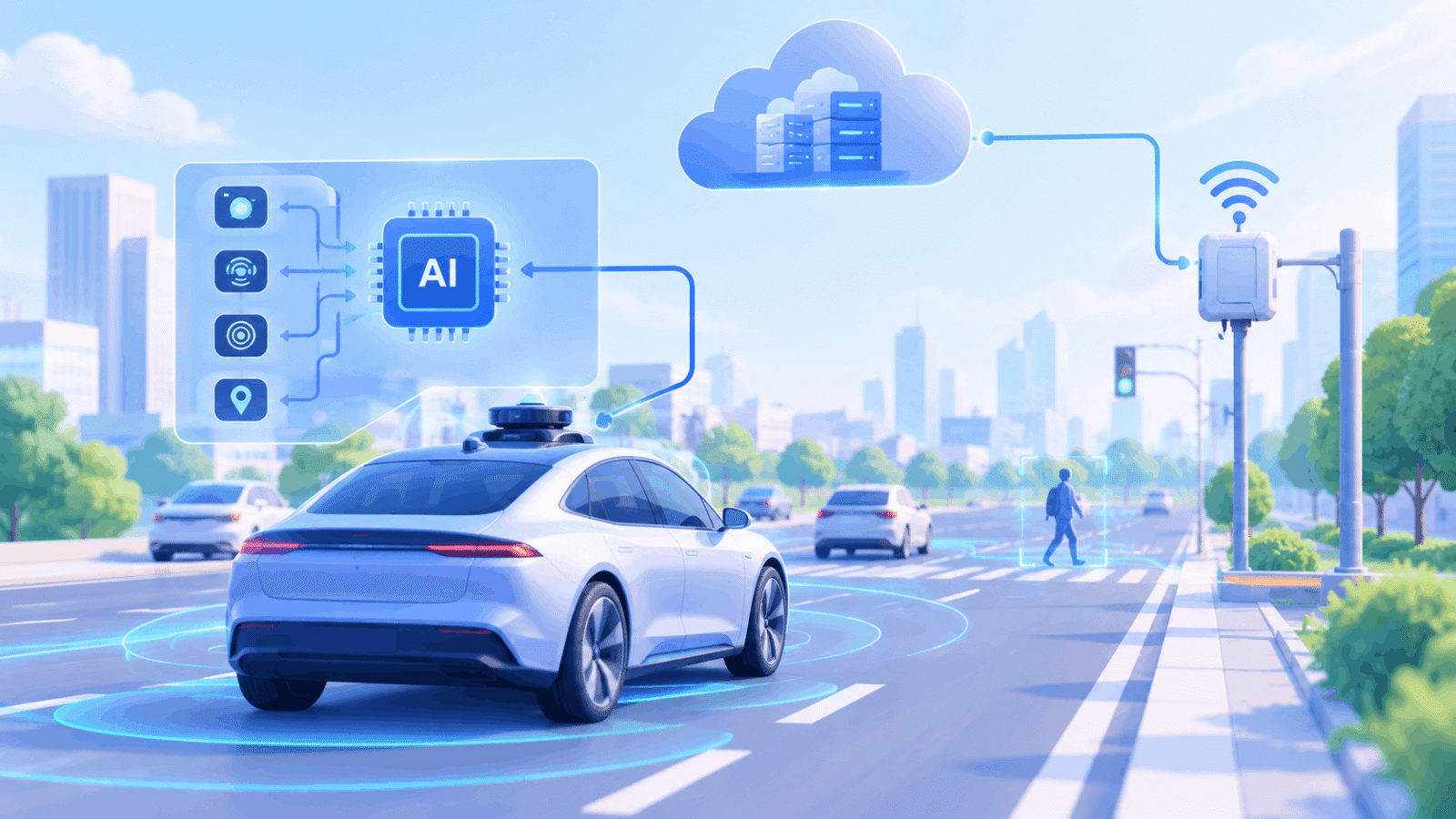
- Edge computing processes sensor data directly inside the vehicle instead of sending it to a distant cloud server first, which is essential when a braking decision can’t wait on a network round trip.
- A single autonomous vehicle can generate estimates of up to 4 terabytes of data per day, far more than any practical wireless connection can stream to the cloud in real time.
- Different driving tasks have very different latency tolerances: remote driving needs under 20 milliseconds, cooperative sensing needs under 10 milliseconds, while cooperative awareness updates can tolerate up to 100 milliseconds.
- Most production systems run a hybrid model. The edge handles split-second decisions like steering and braking; the cloud handles fleet-wide learning, mapping updates, and non-urgent analysis.
- Chips like NVIDIA’s Drive Orin, capable of 254 trillion operations per second, exist specifically because this much processing has to happen locally, inside the car, not in a data center.
What edge computing means in this context
Edge computing in autonomous vehicles refers to processing data close to where it is generated, primarily inside the vehicle or through nearby edge infrastructure, rather than sending every task across a network to a distant cloud server first. In autonomous vehicles, that means processing happens inside the car itself, using onboard chips built specifically for this kind of workload, rather than relying on a connection to an off-site data center for every decision.
The distinction matters because of what’s actually at stake. A recommendation engine can afford to wait a few hundred milliseconds for a cloud response. A self-driving car deciding whether to brake for a pedestrian cannot.
Why the cloud alone can’t handle it
Two problems make cloud-only processing unworkable for real-time driving decisions: the sheer volume of data, and the physical limits of network latency.
Data volume. A single autonomous vehicle can generate estimates of up to 4 terabytes of data every day, from cameras, LiDAR, radar, ultrasonic sensors, and GPS all running simultaneously. Streaming that volume continuously to a cloud server, for every vehicle in a fleet, isn’t just expensive. It would saturate available bandwidth almost immediately, especially in dense urban areas where many vehicles are operating at once.
Latency. Even a fast network connection introduces a round trip: data travels to a server, gets processed, and a response travels back. That round trip, even under ideal 5G conditions, adds delay that a cloud-only architecture can’t fully eliminate. For safety-critical driving functions, additional network delay can reduce the time available for the vehicle to respond to hazards.
Latency requirements aren’t one-size-fits-all
Not every driving-related task has the same urgency, and understanding the range helps explain why the edge/cloud split isn’t arbitrary. Research benchmarking connected and autonomous vehicle (CAV) applications breaks latency tolerance down by task type:
| Use case | Latency threshold | Reliability requirement |
| Remote driving | Under 20 ms | 99% |
| Cooperative sensing | Under 10 ms | 95% |
| Cooperative maneuver | Under 100 ms | 99% |
| Cooperative awareness | Under 100 ms | 95% |
Cooperative sensing, where a vehicle shares live sensor data with nearby vehicles or infrastructure to expand its effective field of view, has the tightest requirement of all: under 10 milliseconds. That makes a distant cloud-only architecture impractical for such time-sensitive exchanges. It has to happen at the edge, often through direct vehicle-to-vehicle or vehicle-to-infrastructure links.
How the hybrid edge-cloud model actually works
In practice, almost no production autonomous vehicle system relies entirely on either edge or cloud processing. They split responsibilities based on urgency.
On the edge (inside the vehicle):
- Object detection and classification (pedestrians, other vehicles, obstacles)
- Immediate braking, steering, and acceleration decisions
- Sensor fusion, combining camera, LiDAR, and radar data into a single, real-time picture of the environment
- Emergency maneuvers that can’t tolerate any network dependency
In the cloud:
- Fleet-wide machine learning model training, using aggregated driving data from many vehicles
- HD map updates and long-term route optimization
- Non-urgent diagnostics and performance analytics
- Software updates pushed out to the fleet
Autonomous-driving platforms commonly follow this general pattern: onboard chips handle moment-to-moment driving decisions, while cloud infrastructure handles slower, larger-scale learning that improves the system over time. NVIDIA’s DRIVE AGX Orin platform, for example, provides up to 254 INT8 TOPS for concurrent AI inference workloads in vehicles.
V2X: extending the edge beyond the vehicle itself
Vehicle-to-everything (V2X) communication extends this same edge-first logic outward, connecting a car not just to the cloud but to nearby infrastructure, other vehicles, and even pedestrians’ devices. ETSI identifies V2X as a key Multi-access Edge Computing use case, including applications that benefit from processing close to connected vehicles and infrastructure.
- V2V (vehicle-to-vehicle): Cars share position, speed, and intent directly with nearby vehicles.
- V2I (vehicle-to-infrastructure): Vehicles communicate with traffic signals, road sensors, and roadside units.
- V2P (vehicle-to-pedestrian): Vehicles detect and communicate with pedestrians’ connected devices.
- V2N (vehicle-to-network): Vehicles connect to cloud and network-based services for less time-sensitive functions.
Edge computing is what makes V2I in particular practical at scale: roadside units positioned along a corridor can process traffic data locally and relay time-critical updates, like an upcoming signal change or a hazard report, without every message having to round-trip through a centralized data center first. ETSI’s MEC requirements specifically describe roadside applications processing local vehicle and sensor messages and distributing latency-sensitive warnings with very low latency.
Automation levels and why edge computing scales with them
The Society of Automotive Engineers (SAE) J3016 defines six levels of driving automation, from Level 0 (no driving automation) to Level 5 (automated driving under all conditions in which humans can drive). The current J3016 revision continues to define Levels 0 through 5 and describes the roles of the human driver and driving automation system at each level.
As a vehicle moves up that scale, from Level 3 partial automation toward Level 4 and 5, the volume of real-time decisions it has to make without human backup increases substantially, and so does its reliance on edge processing. A Level 2 system with basic driver-assist features has meaningfully lower real-time computational demands than a Level 4 system attempting to operate without any human oversight in complex traffic.
The challenges that remain
Edge computing solves the latency and bandwidth problem, but it introduces its own set of engineering challenges.
Onboard power and heat. Chips capable of hundreds of trillions of operations per second generate real heat and draw real power, both of which are harder constraints inside a moving vehicle than inside a climate-controlled data center.
Hardware cost and redundancy. Safety-critical edge systems typically need redundant hardware, since a single point of failure in the primary compute unit isn’t an acceptable risk when there’s no cloud fallback available in the moment.
Security at the edge. Distributing processing across every vehicle in a fleet also distributes the attack surface. NHTSA identifies cybersecurity as a critical issue for automated and connected vehicle technologies, including the protection of vehicle electronic systems, communication networks, control algorithms, software, users, and underlying data.
Keeping edge and cloud models in sync. A model trained on aggregated fleet data in the cloud eventually needs to be deployed back down to the edge, and keeping thousands of vehicles’ onboard models current without disrupting real-time operation is a genuinely hard coordination problem.
Frequently asked questions
Is edge computing the same as 5G?
No. 5G is a network technology that provides faster, lower-latency connectivity. Edge computing is a processing model, deciding where computation happens. They’re complementary: 5G helps V2X communication move faster, but the core real-time driving decisions still happen on the vehicle’s own onboard hardware, not over the network.
Do self-driving cars need an internet connection to function?
Core onboard driving functions are generally designed to operate without depending on a continuous cloud connection. Edge computing is specifically designed so that critical functions like braking and obstacle avoidance can continue even if connectivity drops. An internet connection is needed for cloud-dependent features like live traffic updates or over-the-air software updates, not necessarily for basic driving functions.
How much data does a self-driving car actually process?
Up to roughly 4 terabytes per day, generated by the combination of cameras, LiDAR, radar, and other onboard sensors running continuously.
What happens if the edge computing system fails while driving?
This is why safety-critical autonomous systems are built with redundant hardware and fail-safe behaviors, such as safely slowing down or handing control back to a human driver, rather than relying on a single point of failure with no backup. NHTSA’s automated driving systems guidance also addresses areas including validation, human-machine interfaces, cybersecurity, crashworthiness, post-crash behavior, and data recording.
Why can’t autonomous vehicles just rely entirely on the cloud?
Network round-trip latency, even on fast 5G connections, introduces delay that safety-critical decisions can’t tolerate, and the sheer data volume involved would overwhelm available bandwidth at any meaningful fleet scale.
Edge computing in autonomous vehicles is really one specific, high-stakes case of a broader pattern in modern computing: processing moving closer to where decisions actually need to happen. If you’re interested in how centralized versus distributed computing tradeoffs play out elsewhere, server-based computing covers the same underlying tension from the opposite direction, where processing is deliberately kept centralized rather than pushed to the edge.
