

Quick Takeaways
- A seed phrase is a 12 to 24-word master key generated when you set up a crypto wallet. It can recreate every private key tied to your funds.
- It’s built using the BIP39 standard: a fixed list of 2,048 words converted into a random, cryptographically secure sequence.
- A 12-word seed phrase has roughly 128 bits of entropy, about 5.4 x 10^39 possible combinations, making brute-force guessing practically impossible.
- The real risk isn’t cracking, it’s handing it over. A January 2026 phishing scam impersonating Trezor support convinced one victim to reveal their seed phrase and drained $284 million in minutes.
- No legitimate wallet company, exchange, or support agent will ever ask for your seed phrase. If someone does, it’s a scam, no exceptions.
What is a seed phrase, exactly?
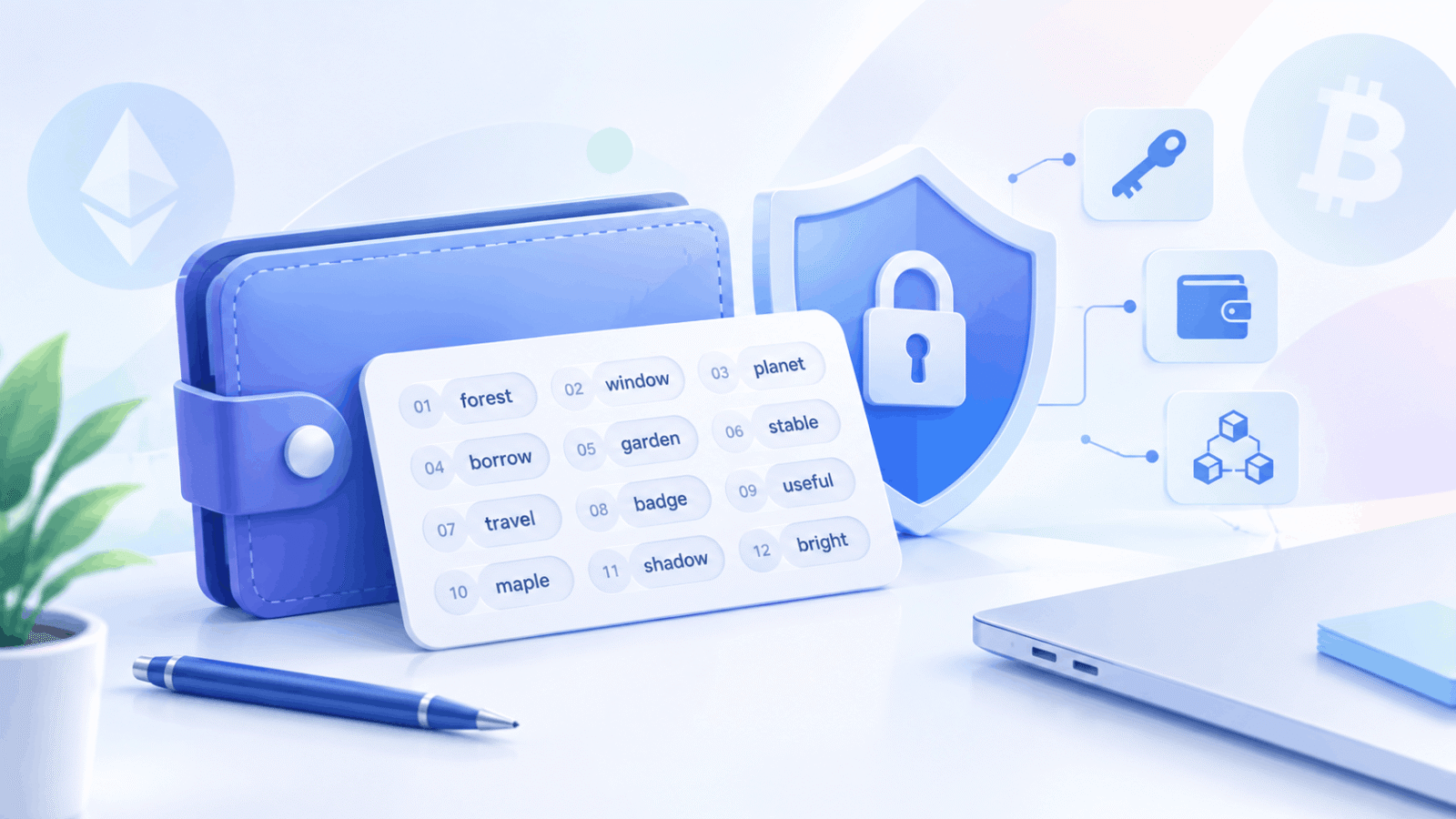
A seed phrase is a sequence of 12, 18, or 24 random words that acts as the master key to a cryptocurrency wallet. It’s generated automatically the first time you set up a non-custodial wallet, and from that single sequence of words, the wallet can recreate every private key needed to access every address and every asset tied to it.
It goes by several other names, all referring to the same thing: recovery phrase, backup phrase, mnemonic phrase, or Secret Recovery Phrase (SRP). Whatever it’s called, the function is identical. It’s not a password you can reset. It’s the literal cryptographic root of the wallet itself.
How a seed phrase is generated: the BIP39 standard
Seed phrases follow a technical standard called BIP39 (Bitcoin Improvement Proposal 39), and understanding roughly how it works explains why the system is trusted with billions of dollars in assets.
- Entropy generation. The wallet generates a large random number (128 to 256 bits) using a cryptographically secure random number generator.
- Word mapping. That random number is split into chunks and mapped against a fixed list of 2,048 predefined English words, the BIP39 wordlist.
- Checksum addition. A checksum is appended to catch typos or transcription errors, which is part of why a single wrong word makes the whole phrase invalid.
- Key derivation. The resulting word sequence is run through a hashing process (PBKDF2) to generate a binary seed, which then derives every private key and address in the wallet using a deterministic structure (BIP32/BIP44).
Because this process is deterministic, the same 12 or 24 words will always regenerate the exact same set of keys and addresses, on any wallet software that follows the BIP39 standard. That’s why a seed phrase generated in one wallet app can be imported into a completely different one and still recover the same funds.
Why it can’t realistically be guessed
A 12-word BIP39 phrase carries about 128 bits of entropy, which works out to roughly 5.4 x 10^39 possible combinations. Even directing all of the world’s combined computing power at guessing it, brute-forcing a truly random seed phrase would take longer than the current age of the universe. A 24-word phrase, at 256 bits, pushes that even further into practically meaningless territory.
This matters because it reframes where the actual risk sits. Nobody is going to guess your seed phrase. They’re going to try to trick you into handing it over.
Seed phrase vs. private key: what’s the difference?
These two terms get used almost interchangeably, but they’re not the same thing.
| Seed Phrase | Private Key | |
| Format | 12-24 human-readable words | Long string of letters and numbers |
| Scope | Can generate many private keys and addresses | Controls one specific address |
| Purpose | Master backup for the entire wallet | Signs individual transactions |
| Portability | Import into any BIP39-compatible wallet | Tied to a single address/wallet format |
A private key is the specific cryptographic credential that authorizes spending from one address. A seed phrase is the human-readable master backup that can regenerate potentially thousands of private keys across multiple blockchains. Losing a single private key might cost you access to one address. Losing, or exposing, a seed phrase puts the entire wallet at risk.
The optional 25th word: what a BIP39 passphrase does
Something most guides skip entirely: BIP39 supports an optional extra word or phrase, sometimes called the “25th word,” added on top of the standard 12 or 24-word sequence. This passphrase isn’t stored anywhere and isn’t part of the generated wordlist. It has to be remembered separately.
Adding one creates an entirely different wallet from the same base seed phrase. This means even if someone obtains your written seed phrase, without the passphrase they’d recover a different, likely empty, wallet. It’s an advanced technique (forgetting the passphrase means permanent loss, with no recovery path at all), but for larger holdings, it adds a genuine second layer that a stolen written backup alone can’t defeat.
Why seed phrases are such a high-value target
Losing a seed phrase to theft isn’t a hypothetical. Blockchain security firm TRM Labs’ 2026 Crypto Crime Report found that infrastructure attacks, which include compromised private keys and seed phrases, drove $2.2 billion in losses across 45 incidents in a single year, the dominant pattern in the report being operational compromise through social engineering rather than technical exploits.
The clearest illustration of that happened in January 2026. An attacker impersonating Trezor customer support convinced a single victim to reveal their recovery seed phrase. The result: roughly $284 million in Bitcoin and Litecoin drained within minutes, the largest phishing loss of the year by a wide margin. No encryption was broken. No hardware was hacked. The attacker didn’t need to, because the victim provided the master key directly.
This is the core lesson seed phrase security keeps coming back to: the cryptography behind a seed phrase is essentially unbreakable. The human being holding it is not.
How to store a seed phrase safely
The safest approach is metal, in at least two copies, kept in two separate locations, never connected to the internet. Here’s how the common methods actually compare:
| Method | Survives fire/water | Survives a hacked account | Rough cost | Verdict |
| Paper | No | Yes, if kept offline | Free | Fine as a first backup, not a final one |
| Metal plate/capsule | Yes | Yes, if kept offline | $50-$100 one-time | Recommended baseline for real holdings |
| Two metal copies, two locations | Yes | Yes | Roughly double the single-copy cost | Best practice for meaningful holdings |
| Photo, cloud note, password manager | No | No | Free | Never do this |
| Split shares (Shamir’s Secret Sharing) | Yes | Yes, and no single share exposes the wallet | Depends on hardware support | Advanced, for larger holdings |
A few rules apply regardless of which method you land on:
- Never store it digitally. No photos, no cloud notes, no password manager entries, no typing it into any website. Anything connected to the internet is one compromised account away from exposing it.
- Never speak it into a voice assistant or messaging app, even to a “support agent.” This is exactly how the January 2026 heist happened.
- Keep more than one copy, in more than one physical location. A single point of failure defeats the purpose of a durable backup.
- Metal beats paper for anything worth protecting. Paper burns and fades. Steel and titanium survive fire, water, and time.
What to do if your seed phrase is compromised
If you believe your seed phrase has been seen, shared, or typed anywhere it shouldn’t have been, speed matters more than anything else:
- Move funds immediately to a brand-new wallet with a freshly generated seed phrase, using a different, trusted device.
- Don’t wait to “confirm” the breach. Anyone who has the phrase can move funds the moment they choose to. Assume the worst and act first.
- Generate the new wallet on a clean, malware-free device, ideally one that was never involved in the exposure.
- Report the incident if it involved an exchange or a specific platform, since some have fraud teams that track stolen-fund flows, even though recovery on-chain is not guaranteed.
There is no “reset password” option in self-custody. A compromised seed phrase can’t be changed. It can only be abandoned in favor of a new one, as fast as possible.
Frequently asked questions
Is a seed phrase the same as a password?
No. A password is typically something you can reset if forgotten or compromised. A seed phrase can’t be reset. It’s the wallet’s cryptographic root, and losing or exposing it is permanent.
Can a seed phrase be used across different wallets?
Yes, as long as both wallets follow the BIP39 standard, which most major wallets do. This is what allows someone to migrate from one wallet app to another without losing funds.
What happens if I lose my seed phrase but still have access to my wallet?
Most wallets let you view or re-export the seed phrase from within the app while you still have access. Once that access is gone, though, there’s no separate recovery path.
Should I memorize my seed phrase instead of writing it down?
It’s not recommended as your only backup. A single misremembered or reordered word makes the phrase useless, and there’s no way to verify a memorized phrase is still correct without writing it down somewhere to check.
Can quantum computers break a seed phrase?
Not currently, and not for the foreseeable future with today’s hardware. This is part of why some security-conscious users opt for 24-word phrases (256 bits of entropy) over 12-word ones, as a hedge against theoretical future advances.
Understanding how a seed phrase works is really a starting point for broader digital security habits. If you’re thinking about how encryption and access control apply more generally, what a network security key does at the network layer and what an access control entry actually governs are two closely related concepts worth understanding alongside it.